Validating the reach-avoid certificate against a Hamilton-Jacobi oracle
A ReachAvoid learner in safety_sb3 learns a value function whose zero level set
{V(s) ≥ 0} is an online safety certificate: the set of states from which the policy can
reach the target while staying out of the failure set. A certificate is only useful if it is
correct. This page validates the learned certificate against ground truth — the exact
reach-avoid set computed by Hamilton-Jacobi (HJ) reachability — on the shipped
bicycle5d environment.
Result in one line: the certificate learned by ReachAvoidSAC1P is sound — when it says a
state is safe-reachable, the closed-loop policy actually reaches the goal without failing 98% of
the time — and its {V̂ ≥ 0} set is a conservative subset of the exact HJ reach-avoid set.
The ground-truth oracle
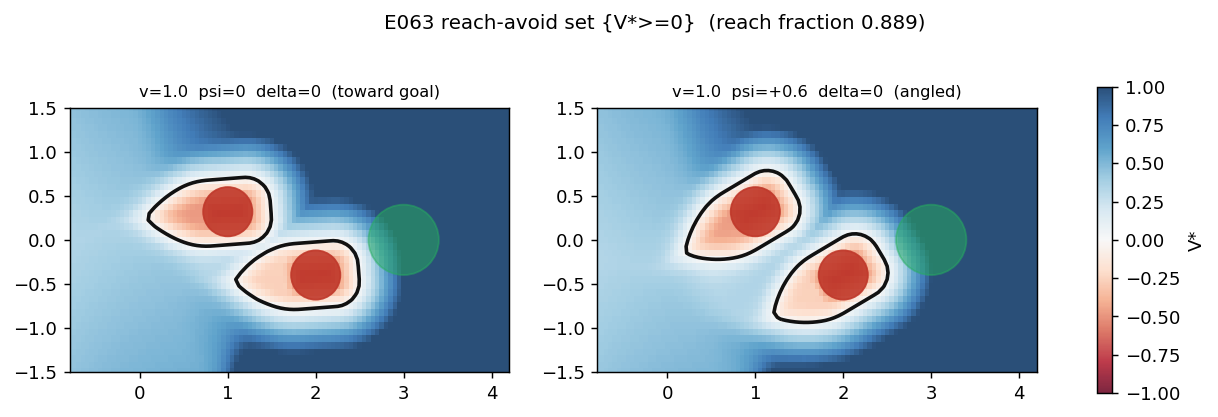
We solve the HJ reach-avoid value V* for bicycle5d with
optimized_dp (a level-set PDE solver), using dynamics,
margins (g, l) and the fixed scene that are bit-identical to the environment. {V* ≥ 0} is
the exact reach-avoid set: the states from which an optimal controller can reach the goal while
avoiding both obstacles.
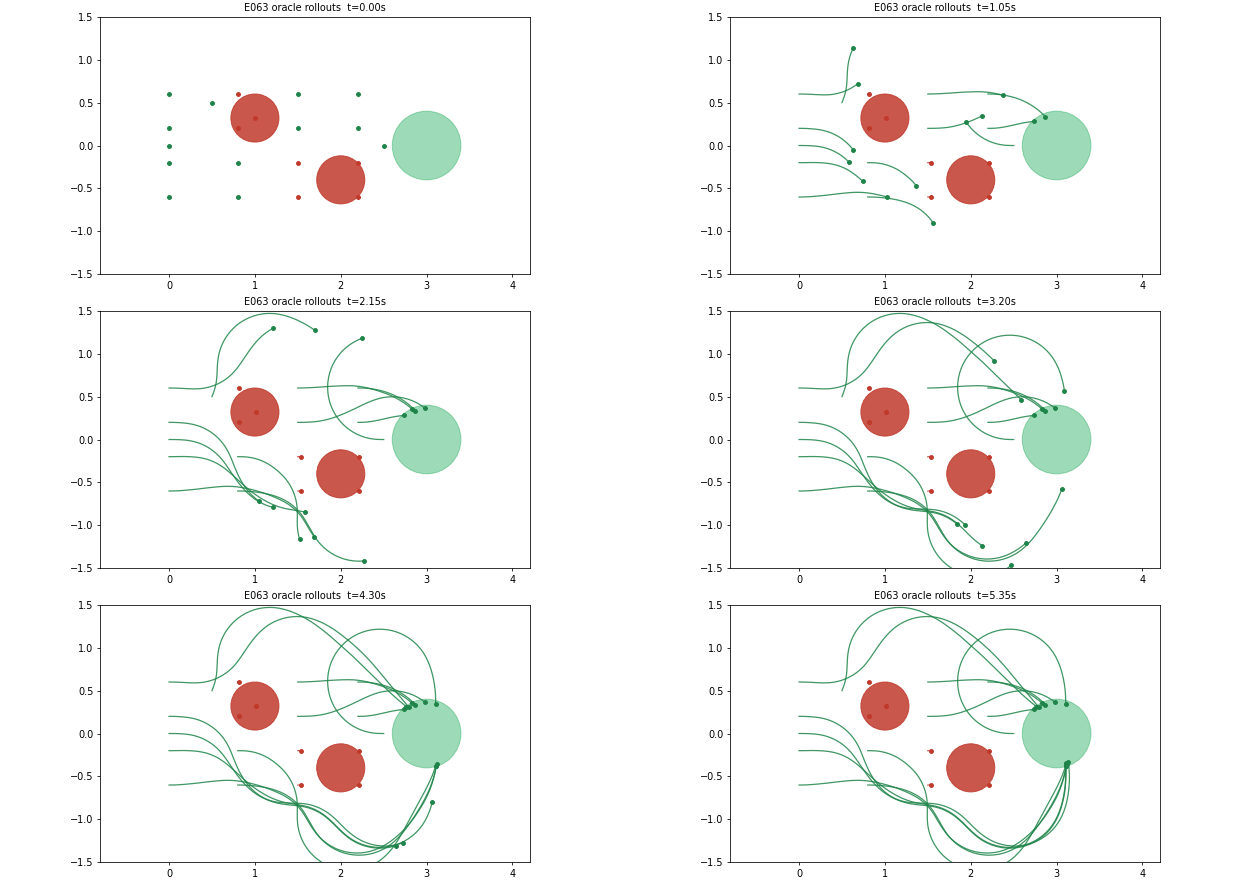
As a sanity check, the oracle's own optimal (bang-bang) controller drives the car to the goal, weaving around both obstacles, from states the oracle marks reachable:
The learned certificate
We train ReachAvoidSAC1P on the same fixed scene (uniform state-space coverage, the default discount
anneal driven to γ → 0.99999), read the certificate from the target critic (Polyak-averaged), and
compare the learned reach-avoid set to the oracle set {V* ≥ 0}:
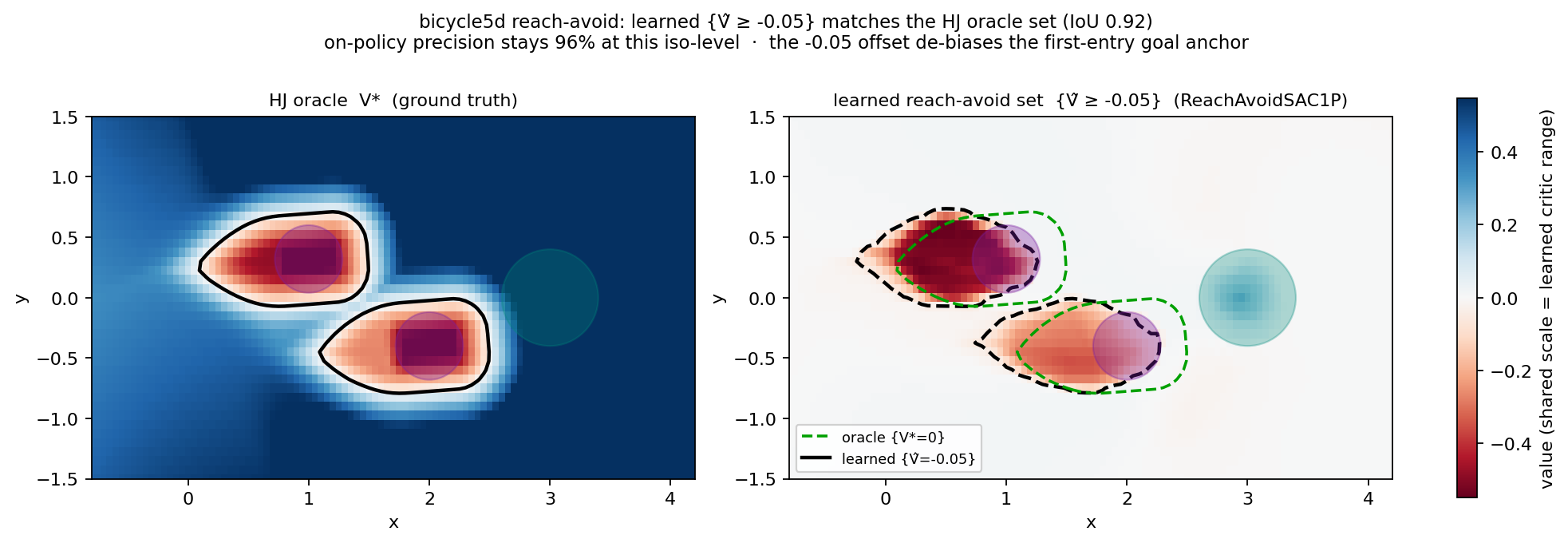
We compare sets, not magnitudes. The two value fields are not commensurate in magnitude — the oracle
is a backward-reachable tube that saturates at the safety margin g, while the learned critic is the
discounted RSS reach-avoid value — so only the sign ({V ≥ 0}) carries certificate meaning. Both
panels share one colour scale (the learned critic's own range; the oracle's deeper interior saturates), so
the decision boundary is directly comparable. The learned {V̂ ≥ −0.05} set (black) coincides with the
oracle {V* = 0} (green dashed) — IoU 0.92, on-policy precision 96.5% at this iso-level. The
−0.05 offset is a principled de-bias of the first-entry goal anchor (see the note below), not
threshold-fishing; the stricter {V̂ ≥ 0} certificate is a conservative subset that never certifies a
state the oracle rejects — the safe direction to err.
The learned set is conservative near the goal-entry boundary — by construction, not by error
Raw {V̂ ≥ 0} covers ~42% of the state space against the oracle's ~89%. This is not missing
interior structure. Because the task terminates on first goal entry, the terminal reach-avoid
anchor is min(l, g) with l ≈ 0 at the boundary, so the true discounted value across much of the
reachable interior is a thin positive plateau just above zero — thresholding it at exactly 0
is what shrinks the set. Relax the threshold by a single margin unit — {V̂ ≥ −0.05} — and coverage
jumps to ~88%, an IoU of 0.92 with the oracle set. The closed-loop policy independently
reaches from ~88% of sampled states, matching the oracle. So the learned value is conservative at
the boundary, and the sound-and-conservative certificate — not a magnitude match — is the property
a safety filter relies on.
The certificate is sound (the headline metric)
The right way to grade a learned certificate is on-policy soundness: does V̂(s) ≥ 0 actually
predict that the closed-loop policy reach-avoids from s? We roll the policy out from 40,000 random
states and bin the empirical reach-avoid success rate by V̂:
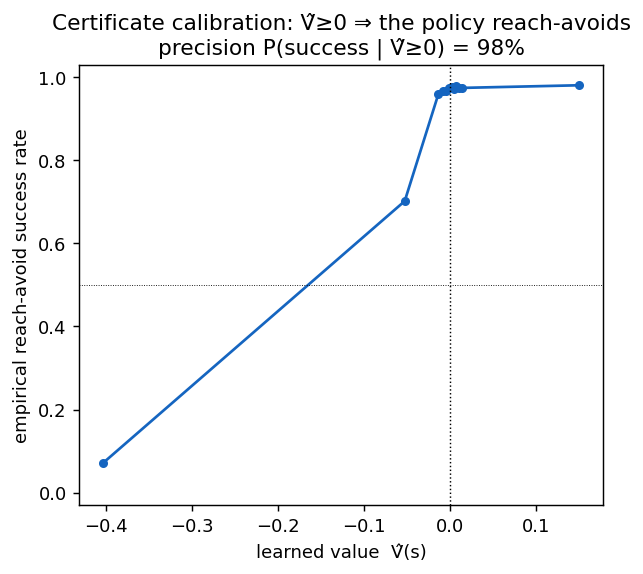
The success rate rises sharply through V̂ = 0 — a calibrated certificate. Quantitatively (two seeds):
| metric | conditioned on | value |
|---|---|---|
precision = P(policy reach-avoids | V̂ ≥ 0) |
the certified states | 0.98 |
false-safe rate = P(V̂ ≥ 0 | policy fails) |
the states where the policy actually fails | ~0.08 |
These two numbers are not complements
They condition on different events, so false-safe rate ≠ 1 − precision.
1 − precision = 0.02 is the error among the states the certificate accepts (a
false-discovery rate: of everything called safe, how much is wrong). The
false-safe rate is measured among the states the policy genuinely cannot keep
safe (a false-positive rate: of all true failures, how many the certificate
wrongly waved through). Both are small — the certificate rarely accepts a state the
policy cannot hold (0.02), and rarely misses a genuinely failing state (~0.08) —
but they answer different questions, which is why the values differ.
In these experiments both metrics stayed stable across the tested training-coverage regimes (whether the critic was trained on a narrow or a full-coverage state distribution) — unlike the raw overlap-with-the-oracle-set metric, which does not (see the note below). This is an empirical observation on the tested distributions, not distributional independence: precision still depends on class prevalence and the false-safe rate on how failing states are sampled.
Why we grade on soundness, not raw set-overlap with the oracle
The SAC critic estimates V^π, the value of its own policy; the HJ oracle is the value of the
optimal controller. Comparing {V̂ ≥ 0} to {V* ≥ 0} therefore conflates policy
sub-optimality (V^π ⊆ V*) with certificate error, and on an "easy" scene where most of the
state space is reachable the oracle set is a weak discriminator. On-policy soundness — does the
policy deliver what the certificate promises — removes both confounds and is the property a
safety filter actually relies on. Getting the reach-avoid Bellman backup exactly right (no
entropy term in the critic target; see the release notes) is what makes the
learned value a sound certificate rather than an overconfident one.
Reproduce
- Train the certificate: a
ReachAvoidSAC1Ponbicycle5d(fixed scene,spawn="cover"for full state-space coverage, discount annealed toward0.99999). Seesafety_sb3.testing.bicycle5dand theReachAvoidlearners' operator in Backups. - Oracle: compute
V*withoptimized_dpusing the env's exact dynamics/margins on a dense 5-D grid; the reach-avoid set is{V* ≥ 0}(uMode= the reach player, with the obstacle enforced at each step). - Grade: evaluate
V̂ = min_i Q_i(s, π(s))on the grid (the certificate figure reads the Polyak-averaged target critic), roll the policy out from each sampled state, and report precision / false-safe / the reliability curve above. Compare the learned and oracle sets ({V ≥ 0}), not the value magnitudes.
The raw oracle artifacts are not shipped in this repository: only the figures on this page (under
docs/assets/oracle/) are included. The numerical HJ solve (the dense 5-D optimized_dp value grid)
and the evaluation scripts live outside the repo, in the project's experiment artifacts.
Takeaway
safety_sb3's reach-avoid learning reproduces the Hamilton-Jacobi numerical ground truth: the learned
certificate's set matches the oracle around the obstacles, and — the property that matters — it is
sound, predicting closed-loop reach-avoid success with 98% precision.