Go2 gap-jumping
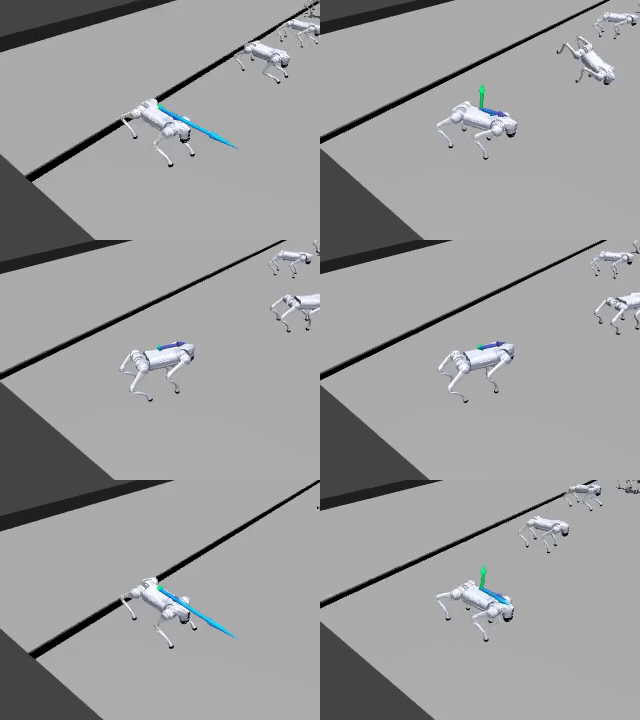
A Unitree Go2 quadruped approaches a pit and must either brake to a safe stop or commit to a leap across it — never stall airborne over the gap. It is the campaign's flagship reach-avoid task: the jump is a committed maneuver (once airborne over the pit, braking is fatal), which is exactly where avoid-only filtering livelocks and reach-avoid is needed.
Status and requirements
| Maturity | Research (a shipped result; forms only through staged warm-starts at real scale) |
| Requires | stock mjlab sim stack; NVIDIA GPU |
| Adversary | go2_gap_chain_isaacs (--adversary → ReachAvoidPPO2P) |
| Action | 12 joint targets (ctrl_dim=12); adversary = 3-dim base wrench |
| Training budget | large — the chain forms its jump only near ~2B env-steps; watch the env/Curriculum/* logger keys |
Success / failure. Failure (g < 0) is a fall or stalling airborne over the
pit; success (l ≥ 0) is arriving past the gap at a stable stop on the far
platform. The jump is a committed maneuver — once airborne over the pit, braking
is fatal — which is exactly where avoid-only filtering livelocks and reach-avoid is
needed.
The pipeline
The jump does not emerge from scratch — it forms through staged warm-starts
(a --load per stage; the lineage is recorded in the experiment log, not in the
registry), each stage seeding a rare-win skill for the next:
| task | objective | learner | warm-starts from |
|---|---|---|---|
go2_gap_landing |
soft-land from mid-air over the gap | SafetyPPO1P (avoid) |
— |
go2_gap_crossing |
reverse curriculum: landing → launch | SafetyPPO1P (avoid) |
landing |
go2_gap_chain |
arrival momentum → brake-or-jump → safe rest | ReachAvoidPPO1P |
crossing |
go2_gap_chain_isaacs |
chain + worst-case base-force adversary | ReachAvoidPPO2P |
chain |
The split test — reach-avoid vs avoid, one variable
The controlled experiment for the claim. Two twins share everything — the same
reverse curriculum over harvested real jump states, the same warm-start, the same
optimizer — and differ in exactly one variable: whether a reach term l is present.
| task | learner | reach term |
|---|---|---|
go2_gap_brake_or_jump_avoid (_w20, _w30) |
SafetyPPO1P |
none (compose(g)) |
go2_gap_brake_or_jump_ra (_w20, _w30) |
ReachAvoidPPO1P |
l_stable_far (compose(g, l)) |
brake_or_jump_harvest.py collects real jump states into a bank;
brake_or_jump.py replays them on a reverse curriculum whose final level is a
decision mixture (far+slow "runway",
near+fast "committed", near+slow "stoppable"). Widths _w20/_w30 widen the gap
(0.12 → 0.20 → 0.30 m) up a warm-started chain.
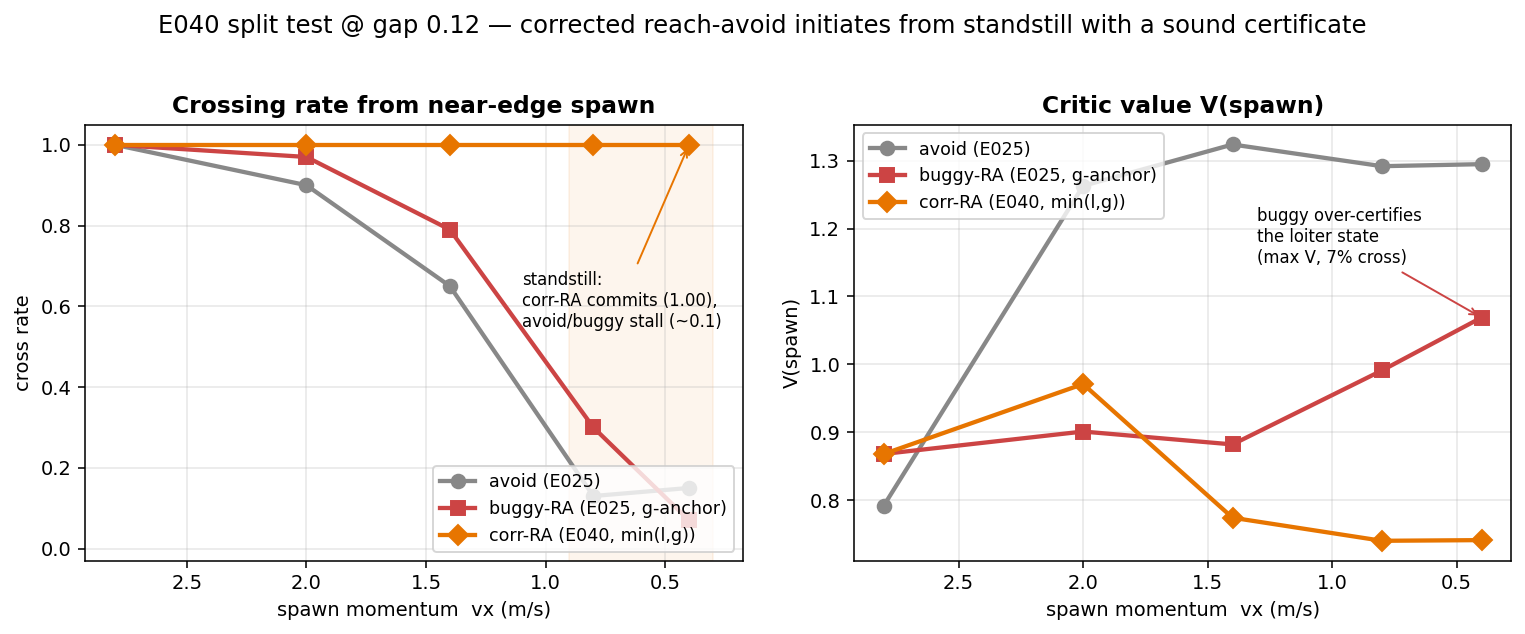
Under the corrected reach-avoid anchor (min(l, g); see
release notes), the
reach-avoid twin initiates the crossing from a standstill — 100% crossing at
every spawn momentum, at all three gap widths, with ~0–1% falls — while the
avoid twin (and a reach-avoid twin trained under the old g-anchor) stalls at low
momentum and its critic over-certifies the non-crossing state. The value is lower
but sound: every point of it is backed by a realized safe crossing.
Live safety filter — defer, then jump
Wrap the blind flat walker in a safety value filter built from each twin's V(s)
+ fallback policy. The robot starts back from the edge and walks forward:
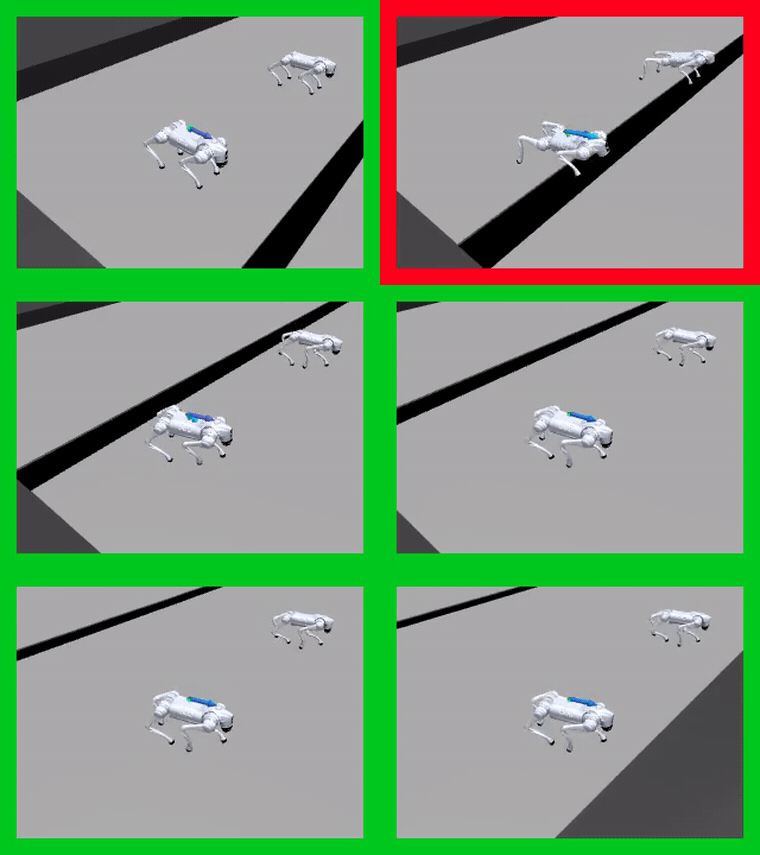
The reach-avoid filter defers to the walker over the whole approach (the state is reach-avoid-feasible), engages only at the edge to execute the jump, and releases after landing — the robot crosses and walks on. The avoid-only filter brakes at the braking boundary and the robot livelocks short of the gap. (Border tint = fraction of the herd under filter control: green walker / red safety fallback.)
Margins
g(safety) =g_terrain_relative:minof terrain-relative base height, tilt, and non-foot contact — negative when the robot falls / plants a non-foot body. Rides on the reward channel; the env terminates ong < 0.l(target) = a rest / gap-completion margin:≥ 0once the robot is past the gap and at a stable stop on the far platform. The avoid twin declares nol.
See robot_safety_sandbox/margins.py and
envs/go2_gap/.
Run it
# reach-avoid chain (single-player)
python examples/train.py --family on_policy --task go2_gap_chain
# + worst-case force adversary (two-player reach-avoid -> ReachAvoidPPO2P);
# use the adversarial task id -- go2_gap_chain has supports_adversary=False
python examples/train.py --family on_policy --task go2_gap_chain_isaacs --adversary

# split test: reach-avoid vs avoid twins, per-gap-width
python examples/train.py --family on_policy --task go2_gap_brake_or_jump_ra   --load runs/go2_gap_crossing/final_model.zip
python examples/train.py --family on_policy --task go2_gap_brake_or_jump_avoid --load runs/go2_gap_crossing/final_model.zip

# evaluate: the critic's value ordering across a momentum sweep
python examples/eval_brake_or_jump_value.py --task go2_gap_brake_or_jump_ra_w30 \
    --ra-model runs/<ra_run>/final_model.zip --avoid-model runs/<avoid_run>
# the live safety filter: the blind walker approaching the gap, filtered
python examples/eval.py --preset gap_gauntlet --task go2_gap_brake_or_jump_ra_w30 \
    --safety-policy runs/<ra_run>/final_model.zip --task-policy runs/go2_walker_flat/final_model.zip \
    --spawn-x -0.8 -0.8 --cmd-vx 0.85 --island-length 3.0 --gap-full-pose \
    --gap-x 0.0 --rest-x 1.2 --num-envs 6 --video ra.mp4
from robot_safety_sandbox import make_tensor, algo_name
env = make_tensor("go2_gap_chain", num_envs=2048)     # ~50k steps/s on 12 GB
# algo_name("go2_gap_chain") -> "ReachAvoidPPO1P";  (..., adversary=True) -> "ReachAvoidPPO2P"
The gap family forms its jump only at real scale (~2B env-steps for the chain);
watch the env/Curriculum/* logger keys — a stalled curriculum looks exactly
like converged training in the reward curve.
Visualize
python examples/play.py --task go2_gap_chain --algo ReachAvoidPPO1P --run runs/go2_gap_chain
Known limitations
- The shipped result ran at reduced scale (1024 envs, not 2048); a scale-matched rerun is the outstanding validation for a paper figure.
- The jump depends on the staged warm-start pipeline — training
go2_gap_chainfrom scratch does not form it. - Evaluation is not bit-reproducible; compare configurations over several runs.
Related source files
robot_safety_sandbox/tasks/go2_gap.py,robot_safety_sandbox/tasks/go2_gap_brake_or_jump.py— task registrations.robot_safety_sandbox/envs/go2_gap/— env cfgs, the harvest/replay pipeline, and margins.robot_safety_sandbox/envs/go2_gap/eval_gauntlet.py— thegap_gauntleteval preset.examples/eval_brake_or_jump_value.py— the critic value-ordering probe.