Tutorial: your first safety environment¶
This is the new-user walkthrough. We build one complete task from scratch — a differential-drive car that must reach a goal while avoiding obstacles — and train a reach-avoid safety policy on it end to end. Every file we touch is small, and every choice is explained from the theory up.
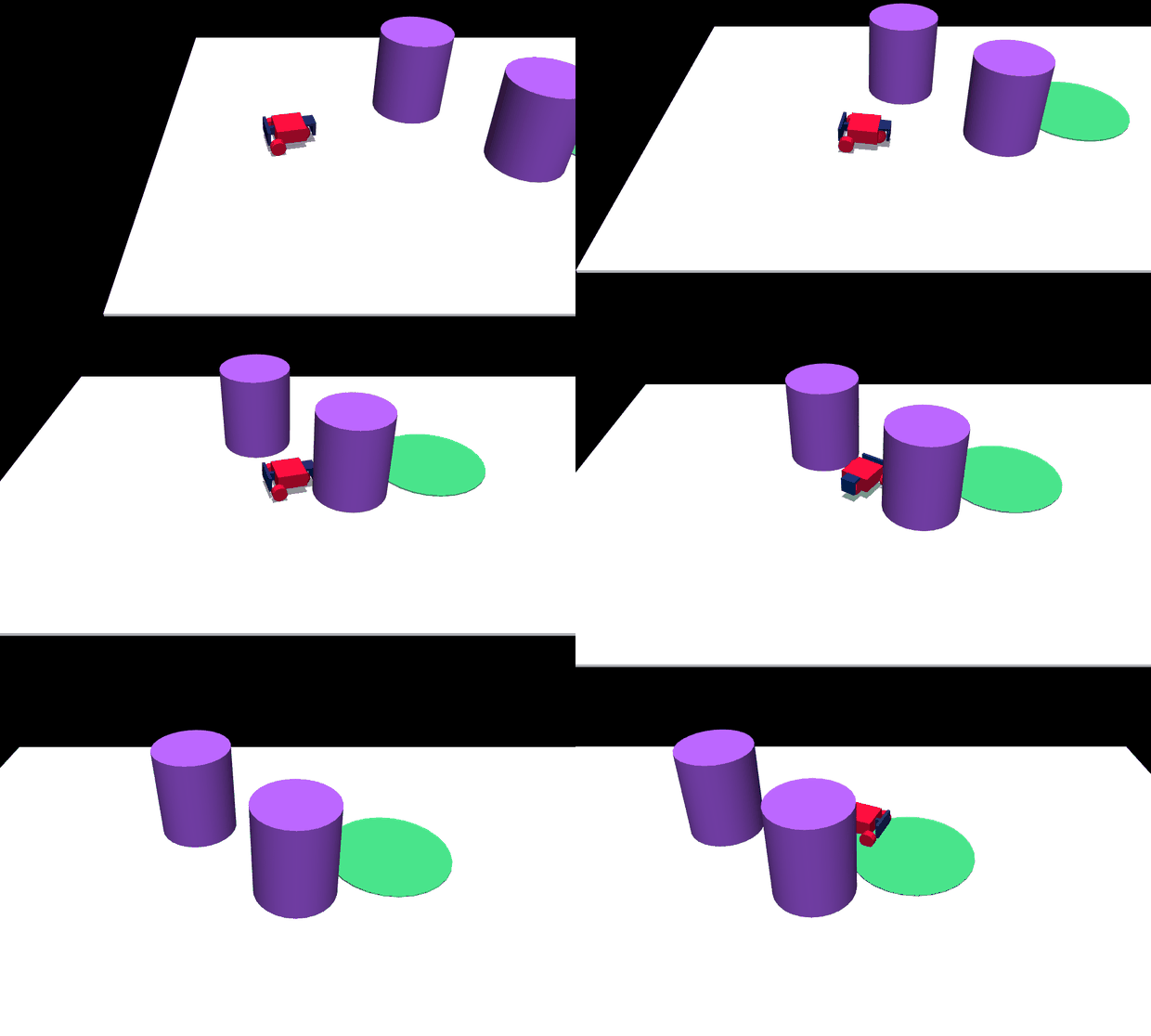
The finished product: a trained ReachAvoidPPO1P policy driving the car from a
standstill, weaving between the two purple obstacles, into the green goal disk.
By the end you will have touched the whole stack once, in the order you would build your own robot:
asset → arena → environment → margins → task → algorithm → config → run.
The three layers you are wiring together
| layer | what it owns | this repo |
|---|---|---|
| mjlab | the physics: MJCF specs, actuators, terrains, the GPU sim | your simulator |
| robot_safety_sandbox (the sandbox) | the safety contract: tasks, margins (g, l), the registry, the two bridges |
this repo |
| safety_sb3 | the learners: {Safety,ReachAvoid}{PPO,SAC}{1P,2P}, on GPU |
the algorithm layer |
The sandbox is the thin, honest middle: it turns a plain mjlab environment into a specification a safety learner can optimize, and nothing more. Learn this one example and you can bring any mjlab robot into the same pipeline.
The finished files live under robot_safety_sandbox/envs/assets/car/,
envs/terrains/car_arena.py, envs/car_goal/env_cfg.py, and
tasks/car_goal.py. Read this page top-to-bottom, then open those four files —
they will read like prose.
0. The one idea: a margin is the specification¶
Classical RL hands the agent a hand-tuned reward and hopes the maximizer does something safe. Safety RL inverts this. You hand the agent two margins, each a signed distance in the world, and the learner solves a reach-avoid problem defined entirely by their sign:
| symbol | meaning | sign convention |
|---|---|---|
g(s) |
safety margin — how far from failure | g ≥ 0 ⟺ safe (outside the failure set) |
l(s) |
target margin — how far into the goal | l ≥ 0 ⟺ reached (inside the target set) |
The failure set is defined as {s : g(s) < 0}; the target set as {s : l(s) ≥ 0}.
There is no separate reward to shape or overfit — the geometry is the task.
The learner approximates the reach-avoid value function (a Hamilton–Jacobi reachability value, learned by RL) with the safety Bellman backup
Read it in words: you can only ever be as safe as your worst future g (the
outer min(g, ·) — one collision anywhere on the trajectory condemns the whole
path), and along a safe path you want to eventually reach (max(l, V') lets a
future arrival raise today's value). V(s) ≥ 0 certifies a control-invariant
reach-avoid state: from here the policy can reach the goal without ever entering
the failure set. That is the object we are training.
Everything below is just supplying g and l honestly for one small robot.
1. The asset — a robot mjlab can drive¶
Files: envs/assets/car/xmls/car.xml, envs/assets/car/car_constants.py
A task needs a body. We copied a minimal differential-drive car MJCF — a chassis
on a free joint, two independently driven wheels (left, right), and a passive
caster — and wrapped it the way every robot in this repo is wrapped: a get_spec
that loads the MJCF, and an EntityCfg that tells mjlab how to actuate it.
# car_constants.py  (abridged)
def get_spec() -> mujoco.MjSpec:
    return mujoco.MjSpec.from_file(str(CAR_XML))

WHEEL_ACTUATOR = BuiltinVelocityActuatorCfg(
    target_names_expr=("left", "right"),   # a velocity servo per wheel
    damping=5.0, effort_limit=2.0, armature=0.001)

INIT_STATE = EntityCfg.InitialStateCfg(
    pos=(0.0, 0.0, 0.1),
    rot=(0.7071, 0.0, 0.0, 0.7071),        # +90° yaw about z  (w, x, y, z)
    joint_pos={"left": 0.0, "right": 0.0}, joint_vel={".*": 0.0})
Why initialize the robot at all?
Two reasons, both about making the task learnable.
- Orientation. The car's mechanical "forward" is its body
-yaxis, but our whole arena is laid out along world+x. The+90°yaw inrotrotates the default pose so forward means+x— the direction the goal lives. Get this wrong and the policy spends its first million steps discovering it must drive sideways. A good default pose aligns the robot's natural DOFs with the task's geometry. - A standstill start.
joint_vel = 0means every episode begins at rest. This is deliberate: it forces the policy to initiate motion. It is the single cleanest way to tell a real reach-avoid policy apart from a lazy avoid one (see §6) — the lazy one just sits still, already "safe", and never reaches.
We drive the wheels with velocity servos, not torques: the policy commands a target wheel speed and the servo tracks it. For a light car this makes the action space forgiving and the diff-drive kinematics (turn by wheel-speed difference) transparent — exactly what you want in a teaching example.
2. The arena — obstacles as keep-out regions, not walls¶
File: envs/terrains/car_arena.py
The world is a flat plate, two obstacle cylinders forming a light slalom, and a
goal disk. In mjlab you add these as geoms inside a SubTerrainCfg.function:
OBSTACLES = ((0.75,  0.32, 0.25),     # (dx, dy, radius), relative to the spawn
             (1.40, -0.32, 0.25))
START_TO_GOAL = 2.0                    # goal is 2 m ahead of the spawn
GOAL_RADIUS   = 0.40

for dx, dy, r in OBSTACLES:
    cyl = body.add_geom(type=mjGEOM_CYLINDER, pos=(ox+dx, oy+dy, H), size=(r, H, r))
    cyl.rgba = PURPLE
    cyl.contype = 0                    # <-- VISUAL ONLY: no physical collision
    cyl.conaffinity = 0
That contype = conaffinity = 0 is the most important line on the page, and the
place newcomers get safety RL wrong.
Why the obstacles are not solid walls
The failure set is defined by the margin, not by physics. If the obstacle
cylinders were collidable, MuJoCo would stop the car at their surface — the car
could never actually enter the region, so g would never go negative, and
the collision termination could never fire. The learner would never see a
single failure and would have nothing to learn to avoid. The world and the
specification would silently disagree.
Making the obstacles visual-only keep-out regions lets the car drive into
{g < 0}; that trips the termination, the episode ends, and the Bellman backup
anchors the value to failure right there. The obstacle is a region in the
margin, not an object in the world. (The goal disk is visual-only for the
same reason: reaching it is an analytic l ≥ 0 event; it must not physically
shove the car.)
The layout is fixed and identical across arenas; per-episode variety comes from
a randomized car spawn (§3), so the visual geoms and the analytic g can never
drift apart — the obstacle you see is exactly the obstacle in the math.
The palette (light floor, purple hazards, green target) is chosen so the showcase
GIF reads at a glance. Rendering uses color_scheme="height" so each geom keeps
its own color instead of a uniform grey.
3. The environment — scene, senses, actions, resets¶
File: envs/car_goal/env_cfg.py
Now assemble a ManagerBasedRlEnvCfg: the mjlab object that says what the robot
senses, how it acts, and when an episode ends. This is plain mjlab — no safety
concepts leak in yet.
Observations — why car-frame¶
obs_terms = {
    "root_vel":  ObservationTermCfg(func=obs_root_vel),      # (vx, vy, wz) in the body frame
    "goal":      ObservationTermCfg(func=obs_goal_car),      # goal offset, rotated into the car frame
    "obstacles": ObservationTermCfg(func=obs_obstacles_car), # each obstacle (dx, dy, r), car frame
}
Why rotate everything into the car's frame?
Invariance = sample efficiency. The correct action ("the goal is front-left,
an obstacle is dead ahead, so arc right") depends only on where things are
relative to the car — not on the car's absolute (x, y, yaw) in the world.
Feeding egocentric observations makes the policy automatically generalize over
every spawn position and heading: it learns one reactive rule instead of
re-learning it in each corner of the arena. This is why we bother with the
quat_apply_inverse that maps world offsets into the body frame, and why the
randomized spawn heading (below) is free variety rather than a new task.
The car senses its own planar velocity and yaw rate (so it can tell if it is
already moving), plus the goal and both obstacles as egocentric (Δx, Δy) vectors.
That is the complete, minimal state needed to solve the task — nothing more.
Actions — the two wheels¶
actions = {"wheels": JointVelocityActionCfg(
    entity_name="robot", actuator_names=(".*",), scale=20.0, use_default_offset=True)}
Two numbers in [-1, 1], scaled to a wheel-speed target of ±20 rad/s (≈ 1 m/s top
speed). Drive both forward → go straight; drive them apart → turn. That is the
entire control interface, and it is why ctrl_dim = 2 in the task spec (§5).
Events — the randomized standstill spawn¶
"reset_base": EventTermCfg(func=reset_root_state_uniform, mode="reset", params={
    "pose_range": {"x": (-0.2, 0.2), "y": (-0.3, 0.3), "yaw": (-0.4, 0.4)},
    "velocity_range": {}})     # empty -> zero initial velocity -> starts from REST
Small position and heading jitter in each episode provide anti-memorization pressure (combined with the egocentric obs, it teaches a reactive policy). The empty velocity range keeps the standstill start from §1 — the property that makes the reach-avoid-vs-avoid contrast meaningful.
Terminations — when the episode ends¶
terminations = {
    "time_out":  TerminationTermCfg(func=time_out, time_out=True),
    "collision": TerminationTermCfg(func=car_collision),   # fires on g < 0
}
car_collision returns g < 0: entering an obstacle is an absorbing failure.
Making it terminal is what lets the safety backup anchor the value to the failure
value at the collision state (mirroring the reference terminated = g < 0). The
reach termination is added automatically by the sandbox — see §5.
The play argument and the viewer
car_goal_env_cfg(play=False) returns a fresh config every call, so training
and rendering never share mutable state. The ViewerConfig at the bottom of
the file is what produced the GIF above (a chase camera; max_extra_envs=0 and
a single terrain patch for a clean single-arena shot).
4. The margins — supplying g and l¶
File: envs/car_goal/env_cfg.py (the car_margins function)
This is the heart of the task, and the whole reason the sandbox exists. Two signed
distances, each ≥ 0 when good:
def car_margins(env):
    p = _car_local_xy(env)                                     # car position, spawn-relative
    obs = _obstacles(p.device)                                 # (M, 3): dx, dy, r
    clearance = ‖p − obs[:, :2]‖ − obs[:, 2] − CAR_RADIUS      # signed gap to each obstacle
    g = (clearance.amin(dim=1) / G_SCALE).clamp(-3, 3)         # nearest obstacle -> safety

    dist = ‖p − goal‖
    l = ((GOAL_RADIUS − dist) / L_SCALE).clamp(-3, 3)          # inside the disk -> reached
    return g, l
g= distance from the car's footprint to the nearest obstacle surface. Positive in free space, exactly0at the keep-out boundary, negative once the car overlaps an obstacle. Theaminover obstacles encodes "safe means clear of all of them" (min= logical AND).l=goal_radius − distance_to_goal. Positive inside the disk, negative outside. It stays graded all the way back to the spawn (viaL_SCALE), so the reach gradient never flattens to zero far from the goal — the policy always feels a pull toward the target.
Why normalize and clamp every margin?
The margins are the Bellman targets. If g ranged over meters and l over
centimeters, the critic would see wildly different scales and the min/max
backup would be dominated by whichever term is numerically larger — not the one
that is physically closer to its boundary. Dividing by an O(1) scale and
clamping to ±3 keeps both terms comparable and the value bounded, which is
what keeps the safety Bellman iteration stable. The sign carries the
specification; the scale must not distort it.
Here is what these two margins look like — the trained policy's actual path
plotted over the geometry g and l encode:
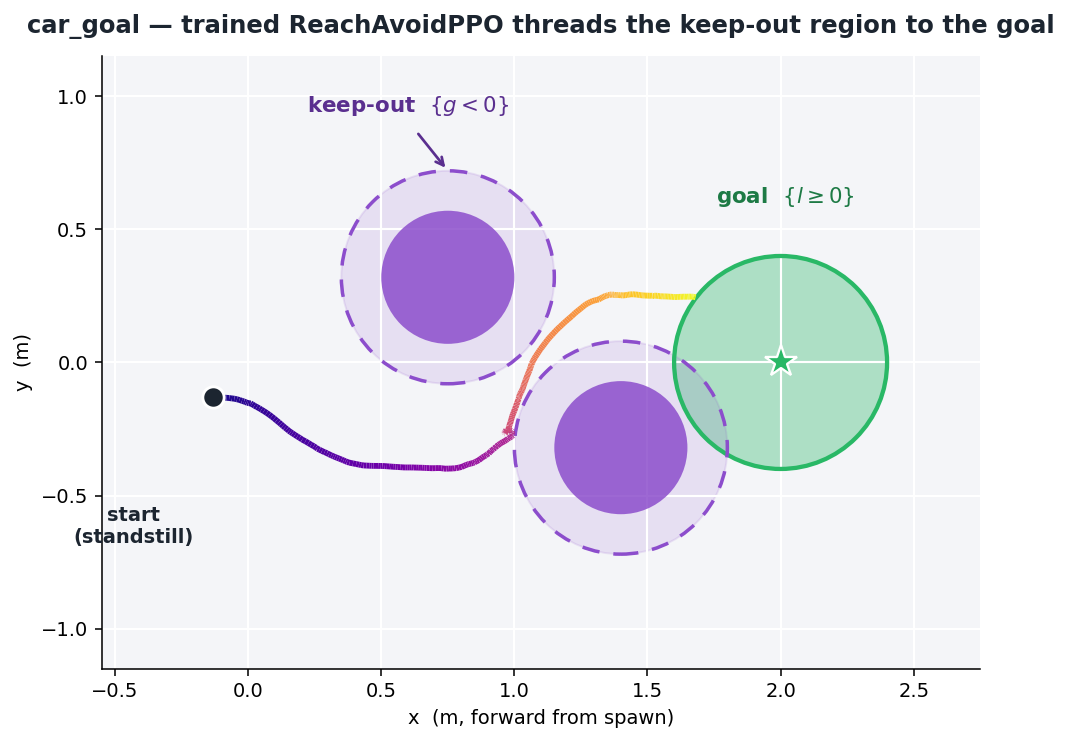
The dashed purple circles are the g = 0 boundary (obstacle radius + car
radius): the set the car's center must stay outside. The green disk is the
l ≥ 0 target. The path (dark → bright with time) is the trained rollout —
from a standstill it arcs below the first keep-out region, threads the gap, and
enters the goal. Nowhere does it cross a dashed circle: it stays in {g ≥ 0} the
whole way and terminates on {l ≥ 0}. That is a realized reach-avoid trajectory.
5. The task — one registration ties it together¶
File: tasks/car_goal.py
A task is exactly three things: an mjlab config builder, a margin function, and
a TaskSpec that records how to train it. Register once, and both GPU/PPO and
SB3/SAC bridges can build it.
register(TaskSpec(
    task_id="car_goal",
    cfg_builder=car_goal_env_cfg,       # §3  — the plain mjlab environment
    margin_fn=car_margins,              # §4  — supplies (g, l)
    ctrl_dim=2,                         # §3  — two wheel commands
    mode="reach-avoid",                 # this is a REACH-avoid task
    supports_adversary=False,           # single-player (no disturbance agent)
    end_criterion="reach-avoid",        # end on reach OR collision (see below)
    description="Drive to the goal disk while avoiding obstacle cylinders."))
The MAP — Mode. Algorithm. Players.
mode is the ONLY thing a task says about its learner. The learner's name
is three letters concatenated, and each comes from one place:
| letter | source | here |
|---|---|---|
| Mode | the task's mode= (a property of its margins) |
ReachAvoid |
| Algorithm | the run's --family (on_policy→PPO, off_policy→SAC) |
PPO |
| Players | the run's --adversary |
1P |
task mode |
1-player | 2-player (--adversary) |
|---|---|---|
"safety" (avoid) |
SafetyPPO1P |
SafetyPPO2P |
"reach-avoid" |
ReachAvoidPPO1P |
ReachAvoidPPO2P |
car_goal declares a target (l), so mode="reach-avoid". We run it
single-player on the PPO family, so the learner resolves to
ReachAvoidPPO1P. (Declaring mode="reach-avoid" on a task whose margins
carry no target is refused by the registry — see §6.)
end_criterion="reach-avoid" tells the env to end the episode on arrival
(g ≥ 0 ∧ l ≥ 0) as well as on collision. For a "drive there and stop" task this
is the natural choice — reaching the goal is success. (The alternative,
"failure", keeps going after arrival so the value can climb deeper into the
target; see termination.)
Finally, wire the registration into the package so it loads on import:
# robot_safety_sandbox/__init__.py
from .tasks import car_goal as _car_goal; _car_goal.register_all()
That is the whole task. make_tensor("car_goal") now works.
6. The algorithm — why reach-avoid, not avoid¶
Learner: safety_sb3.ReachAvoidPPO1P
The task resolves to ReachAvoidPPO1P, and it has to. Here is the discriminating
thought experiment this whole environment is built around:
Avoid vs reach-avoid, on the same car
- An avoid policy only cares about
g. At the spawn, the car is already in free space,g > 0— it is already safe. So the optimal avoid policy is to sit still forever. It never reaches the goal, and it is perfectly happy. - A reach-avoid policy optimizes the coupled value: it must keep
g ≥ 0and drivelup to the goal. From a standstill it must initiate the maneuver, weave through the keep-out regions, and arrive.
That is why the standstill start (§1) and the target margin (§4) matter: they
turn "avoid" and "reach-avoid" into visibly different behaviors on identical
hardware. reach_rate(reach-avoid) ≫ reach_rate(avoid ≈ 0).
The training recipe (in the config below) is the hard-won default for this repo's
PPO family: normalize_obs=True (normalize observations only — never the margins,
which carry the specification), a small entropy bonus, log_std_init = ln(0.3),
adaptive learning rate, and short rollouts. You inherit all of it from
examples/train.py; you do not re-derive it.
Gamma annealing is on by default
Reach-avoid values are notoriously hard to bootstrap at γ = 1. The learner
starts at γ = 0.99 and anneals toward 1 on a schedule, so the value first
learns a well-shaped near-horizon estimate and then stretches it to the true
reach-avoid horizon. You do not configure this — it is the default. (See the
safety_sb3 hyperparameters.)
7. The config and the run¶
File: configs/car_goal.yaml
Rather than a wall of argparse flags, a run is a small recipe. Keys are flag
names; explicit CLI flags still override the file (argparse defaults < config <
CLI), and every run also dumps its fully-resolved config next to the checkpoints
for exact reproduction.
# configs/car_goal.yaml
family: on_policy        # PPO family
task: car_goal
num_envs: 1024
steps: 25_000_000
seed: 0
net: "256,256"
ent_coef: 0.003
lr: 0.0005
adaptive_lr: true        # KL-adaptive LR (desired_kl 0.01)
gamma: 0.99              # base discount...
gamma_anneal: true       # ...annealed 0.99 -> 0.999 -> 0.9999 over training
video_interval: 2_000_000
Why the discount is annealed
The gamma_anneal is load-bearing for this task. The reach-avoid value is
a Hamilton–Jacobi value; annealing γ toward 1 recovers the true (undiscounted)
reachability value, which is what lets the policy plan the long weave through the
slalom from a standstill rather than lunging at the goal. Training with a fixed
low γ reaches far less reliably. (The value's explained_variance dips late as
γ→0.9999 makes the near-undiscounted target harder to fit — that is expected and
does not mean the policy is worse.)
Launch it:
python examples/train.py --config configs/car_goal.yaml
That is the entire command. The trainer resolves the learner from the task
(car_goal × PPO family × single-player → ReachAvoidPPO1P), builds 1024 GPU environments,
prints the resolved end-criterion and recipe, streams telemetry to wandb, saves
periodic videos, and writes runs/car_goal/final_model.zip +
tensornormalize.pt at the end.
# or drive it yourself
from robot_safety_sandbox import make_tensor, algo_name
env = make_tensor("car_goal", num_envs=1024)      # GPU-resident tensor path
# algo_name("car_goal") -> "ReachAvoidPPO1P"
8. The result¶
At 25M env-steps the trained policy drives to the goal from a standstill,
weaving through the slalom without entering a keep-out region — the rollout in the
GIF at the top, and the path in the margin diagram in §4. On a held-out sweep of
512 randomized spawns, the canonical run (seed 0) reaches ≈67% of them with
0% constraint violations (it never touches the obstacle boundary); across
seeds, the reach rate averages ≈60%, with a single-digit violation rate. A pure
avoid policy on the same env sits at ≈0% reach — it stays safe by never
setting off — so the reach rate is exactly what separates a real reach-avoid
policy from a lazy one.
Measuring it yourself
python examples/eval.py --task car_goal \
    --safety-policy runs/car_goal/final_model.zip --safety-only \
    --no-filter --num-envs 512 --steps 700
task_success (reach rate), safe_rate, and violation_rate.
You have now built, from nothing, a complete safety task and trained a certified reach-avoid policy on it. Every robot in the environments showreel is the same seven steps at greater scale.
Now build your own¶
Use car_goal as a template and swap one piece at a time:
- Asset — drop in your robot's MJCF and write a
*_constants.py(get_spec+EntityCfg+ actuators + a task-aligned initial pose). - Arena — a
SubTerrainCfg.functionthat adds your hazards as visual-only keep-out geoms and returns the spawn origin. - Environment — a
ManagerBasedRlEnvCfg: egocentric observations, your action interface, a randomized reset, ag < 0termination. - Margins — a
(g, l)function; normalize and clamp, let the sign carry the spec. Seemargins.pyfor reusable terms. - Task — one
TaskSpec(mode,end_criterion,ctrl_dim), and a line in__init__.py. - Algorithm — inherit the recipe; the MAP does the rest:
modepicks avoid vs reach-avoid (by whether you declared anl),--familypicks PPO vs SAC,--adversarypicks 1P vs 2P. - Config + run — a
configs/*.yamlandpython examples/train.py --config ….
Deeper references: the API guide (the g/l contract, TaskSpec,
end_criterion), Extending (margins, sensors, terrains, contacts),
and Porting a task. For the learners and their knobs, see
safety-stable-baselines.